
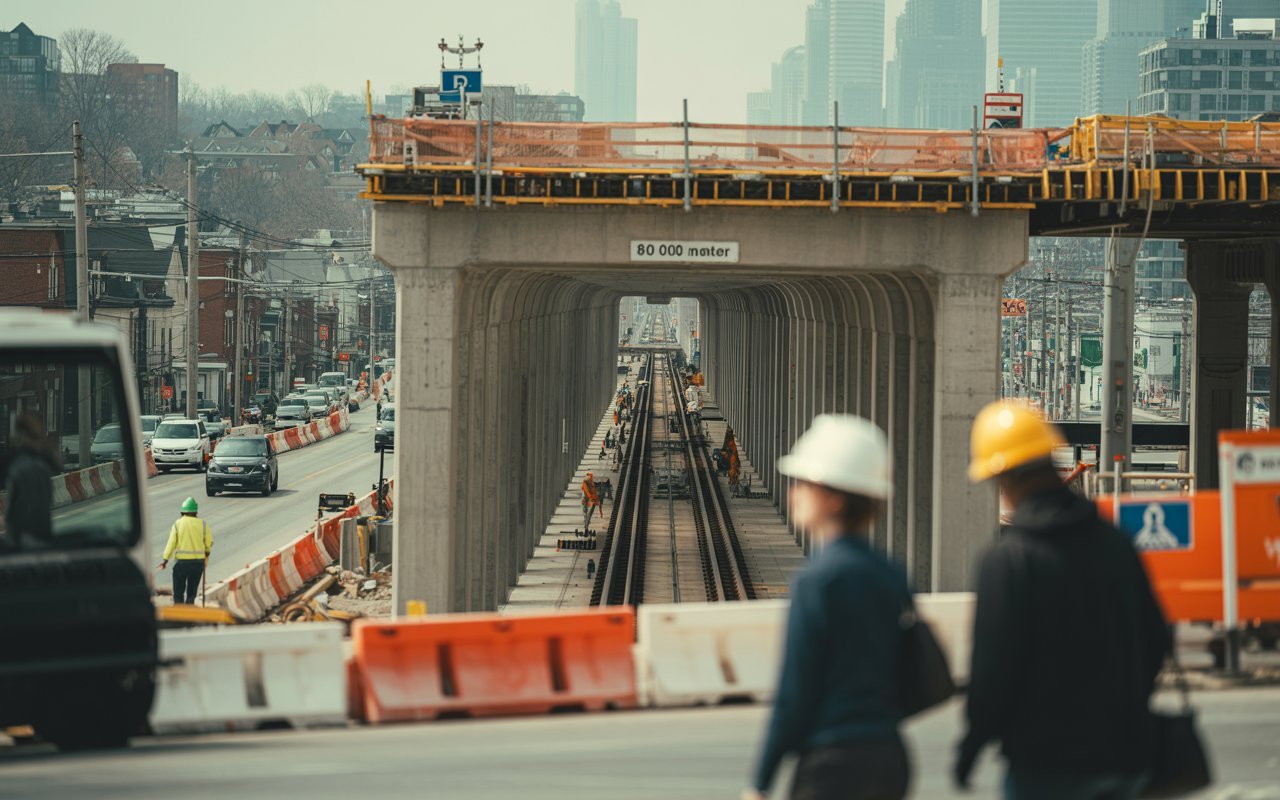
The Ontario Line Value Lift: Where the 800-Meter Mark Matters
Property owners and investors across Toronto are asking the same question: how much will the Ontario Line increase my property value? The simple answer that most people expect—”properties near transit are worth more”—misses the more complex and financially significant reality that proximity to transit follows a bell curve, not a straight line.
At Innovative Property Solutions, we appraise properties throughout Toronto’s future Ontario Line corridor, and the research-backed data reveals something that surprises most people: the properties that will see the largest value increases aren’t necessarily the ones right next to the stations. The real value sweet spot sits between 500 and 800 meters from stations, where buyers get all the transit convenience without the drawbacks of being directly adjacent to subway infrastructure.
Understanding this bell curve of transit value matters enormously if you own property along the Ontario Line corridor or if you’re considering an investment in these neighbourhoods. The difference between buying at 200 meters versus 700 meters from a station could mean the difference between modest returns and exceptional appreciation.
The 120 Percent Potential and How It Actually Works
Research on rail transit impact consistently shows that proximity to stations can increase land values significantly, with some properties experiencing increases up to 120 percent compared to similar properties without transit access. This dramatic appreciation occurs because transit infrastructure reduces travel time and transportation costs, and these savings get capitalized directly into property values.
The economic logic is straightforward. If a new subway station saves you 30 minutes per day on your commute, that time savings has real monetary value. Over months and years, those time savings add up to thousands of dollars in value. Buyers recognize this and willingly pay more for properties that provide these transportation benefits.
But here’s what most simplified analyses miss: this value doesn’t distribute evenly across all properties near the transit line. Distance from stations matters, but not in the linear way people assume. Closer isn’t always better, and understanding why requires looking at what transportation economists call hedonic pricing models.
Hedonic pricing breaks down property values into component attributes. Location, size, age, condition, and dozens of other factors each contribute to overall value. Transit proximity is one attribute, and like other attributes, it has an optimal range rather than a “more is always better” relationship.
Transit stations provide benefits including reduced commute times, access to employment centers, reduced need for car ownership, and connection to the broader transit network. These benefits increase property desirability and therefore value.
But stations also create what economists call disamenities. These include increased noise from trains and passengers, higher pedestrian and vehicle traffic, perception of increased crime near transit nodes, visual impacts of station infrastructure, and changes to neighbourhood character as density increases around stations.
The balance between these benefits and drawbacks creates the bell curve. At optimal distances, you get maximum transit benefits with minimal disamenity impacts. Too far away and you lose the convenience benefits. Too close and the disadvantages start outweighing the advantages.
The 500 to 800 Meter Sweet Spot
Meta-analyses examining transit impact across multiple cities and transit systems reveal that the largest land value impacts typically occur between 500 and 800 meters from stations. This distance range represents roughly a 6 to 10 minute walk, which most people consider reasonable for daily transit use.
At 500 to 800 meters, properties are close enough that residents use transit regularly. The commute savings are real and meaningful. Walking to the station takes less than 10 minutes, which compares favourably to the time required to drive, find parking, and walk from a parking spot in most urban areas.
But at this distance, the negative impacts of station proximity largely disappear. Noise from trains isn’t noticeable. Passenger traffic doesn’t affect your street. Station parking and pick-up areas don’t create congestion in your immediate neighbourhood. You get the benefits without the drawbacks.
This sweet spot affects different property types differently, but the general pattern holds across residential and commercial properties. The maximum value uplift occurs not at the station itself but at this middle distance, where transit convenience remains high but environmental impacts are minimal.
Properties at 300 to 400 meters often see nearly comparable value increases to those at 500 to 800 meters because they’re still within easy walking distance. But as you get closer than 300 meters, disamenity factors start reducing the net value benefit significantly.
Understanding this distance dynamic helps explain why some properties near transit don’t appreciate as much as owners expected. Location at 150 meters from a station might seem better than 700 meters, but market behaviour consistently shows that buyers value the 700-meter location more highly once they consider the full living experience.
The Disamenity Zone Under 200 Meters
Properties located within 200 meters of stations face unique challenges that can actually suppress values relative to properties at moderate distances. This isn’t theoretical. Market data from multiple transit systems shows that the very closest properties to stations sometimes see minimal value increases or even value decreases compared to similar properties at greater distances.
The disamenity factors affecting these closest properties are real and measurable. Noise represents the most obvious concern. Train operations create a sound that nearby residents hear regularly. While modern construction and soundproofing can mitigate this, the noise remains a factor that affects property desirability.
Station areas generate pedestrian and vehicle traffic that affects surrounding streets. Kiss-and-ride zones where people drop off transit riders create congestion during peak hours. Parking facilities for transit users take up space and create visual impacts. These traffic patterns change neighbourhood character in ways that don’t appeal to all buyers.
Perceived safety concerns affect properties closest to stations more than those at moderate distances. Whether these perceptions reflect actual crime statistics or not, buyer concerns about safety near transit nodes influence their willingness to pay premium prices for the closest locations.
Aesthetic impacts of station infrastructure, including ventilation grates, emergency exits, station entrances, and related equipment, affect the immediate surroundings more than properties a few blocks away. While transit agencies design stations to minimize visual impact, the infrastructure necessarily affects nearby properties more than distant ones.
The shift toward higher density near stations creates neighbourhood character changes that some existing residents view negatively. If you bought a single-family home in a quiet neighbourhood and a 40-story condo tower goes up two blocks away, you might not view that as a positive change even though transit access improves.
When we appraise properties in the disamenity zone at Innovative Property Solutions, we account for these factors through careful analysis of comparable sales showing how the market actually values properties at various distances from transit infrastructure.
Commercial Versus Residential Value Impact
The value uplift from transit proximity affects commercial properties differently from residential, and understanding these differences matters for investment decisions and property owner expectations.
Commercial properties generally experience larger percentage value increases from transit proximity than residential properties. This makes sense economically because commercial tenants place a high value on transit access for employees and customers. Office buildings near transit can attract quality tenants willing to pay premium rents. Retail spaces benefit from pedestrian traffic that transit stations generate.
The travel time savings that transit provides matter more for daily commutes to work than for residential living. An office worker makes the same commute twice daily, five days per week. The time savings from convenient transit access add up significantly over a year. This economic value translates directly into what commercial tenants will pay in rent, which then capitalizes into property values.
Within residential properties, condominiums see significantly more value uplift than single-family homes. Condo buyers are specifically seeking urban living with transit convenience. They’ve chosen density and vertical living partially because of the transit access and walkability that come with urban locations.
Single-family homeowners have different priorities. While transit access provides value, many single-family buyers prioritize yards, parking, privacy, and neighbourhood character more highly than transit convenience. For some single-family buyers, the densification and neighbourhood changes that come with major transit investment actually reduce desirability.
This doesn’t mean single-family homes near the Ontario Line won’t appreciate. They will. But the percentage appreciation will likely be smaller than comparable condos and substantially smaller than commercial properties in the same locations.
Market data supports these distinctions clearly. Commercial properties within optimal transit distances command rent premiums of 15 to 30 percent compared to similar properties without convenient transit. These rent premiums translate into value increases through income capitalization that exceed residential appreciation percentages.
Heavy Rail Premium Over Light Rail
The Ontario Line represents heavy rail rapid transit rather than light rail, and this distinction matters for value impact. Heavy rail systems consistently generate larger land value increases than light rail systems in comparable markets.
Heavy rail provides faster travel speeds, higher capacity, and more frequent service than light rail. These operational advantages translate into greater time savings and transportation benefits for riders, which then capitalize on higher property values near stations.
The substantial infrastructure investment required for heavy rail also signals long-term government commitment to the corridor. Light rail can be relatively easily modified or even removed. Heavy rail represents a permanent transportation asset that will serve the corridor for generations. This permanence gives buyers and investors confidence that transit benefits will persist, supporting higher property valuations.
Research comparing light rail and heavy rail impacts across multiple cities shows that heavy rail stations generate value uplift approximately 40 to 60 percent larger than comparable light rail stations in similar market conditions.
The Ontario Line’s heavy rail nature means the value impacts will be more substantial than if the same corridor received light rail service. Properties along the corridor can expect appreciation that reflects the superior service and permanence that heavy rail provides.
The Economic Magnitude of Ontario Line Development
The Transit-Oriented Communities program associated with the Ontario Line will reshape entire neighbourhoods through the development it enables. The province’s TOC program at 12 stations along the line is projected to create capacity for approximately 56,000 new residential units and roughly 75,000 new jobs.
This development scale will dramatically increase density and economic activity along the corridor. Neighbourhoods that were predominantly low-rise residential will transition to mixed-use, higher-density communities. Commercial districts will intensify as office and retail space expands near stations.
The employment concentration matters for property values because jobs drive housing demand. Adding 75,000 jobs along the corridor creates demand for housing both within the corridor itself and in surrounding neighbourhoods. This job growth supports property values beyond just the direct transit access benefits.
The 56,000 new residential units represent substantial population growth that will support retail, services, and community amenities that enhance neighbourhood desirability. As these communities mature, the complete community benefits will compound the direct transit access value.
When we appraise properties along the Ontario Line corridor, we consider not just current conditions but the trajectory these neighbourhoods are on as the line approaches completion and TOC development proceeds.
Land Value Capture and Public Policy
The value uplift from transit infrastructure represents what economists call land value capture. The government invests billions in transit construction, which creates an increase in private property value along the corridor. Public policy increasingly seeks to capture some of this private value gain to help fund the transit investment itself.
The TOC program represents one form of land value capture. By selling or leasing development rights at stations, the government recaptures some of the value that transit creates. Property owners still benefit from appreciation, but some of the value uplift funds the transit infrastructure that created it.
Understanding land value capture matters for property owners because it affects government policy toward transit corridors. Future development regulations, density allowances, and even property taxation may be structured to capture more transit-generated value for public benefit.
For investors, land value capture creates opportunities. Properties positioned to take advantage of density increases and development potential near stations offer the chance to participate in value creation that transit enables. But participation requires understanding the regulatory framework and how value capture mechanisms affect development potential.
Investment Strategy for the Ontario Line Corridor
The research on transit value impact translates into clear strategic guidance for property owners and investors along the Ontario Line.
The 500 to 800-meter range from stations represents the optimal investment zone where value uplift potential is highest and disamenity risks are lowest. Properties in this range get maximum benefit from transit proximity without the drawbacks of immediate station adjacency.
Commercial properties and condo sites offer better appreciation potential than single-family homes in the corridor because the property types align better with transit-oriented development patterns and benefit more directly from transit convenience.
Properties with development potential capture more value uplift than fully built properties because they can participate in the densification that transit enables. Sites that can accommodate density increases through redevelopment or intensification benefit from both transit access and development opportunity.
Early positioning matters because value uplift begins before transit completion as the market anticipates future conditions. Properties along the Ontario Line corridor are already appreciating based on expected transit benefits, even though the line won’t open until later this decade.
At Innovative Property Solutions, we help investors and property owners understand their position along the Ontario Line corridor and how the specific characteristics of their properties affect their value uplift potential.
Get Professional Valuation Guidance
Understanding transit value impact requires specialized expertise that accounts for distance dynamics, property type differences, and development potential along the corridor. Professional appraisal from Innovative Property Solutions provides the detailed analysis needed for confident investment decisions and realistic value expectations.
Whether you own property along the Ontario Line corridor, are considering investment opportunities, need valuation for financing or estate purposes, or simply want to understand your property’s position in the changing market, our expertise in transit impact valuation helps you make informed decisions.
Contact Innovative Property Solutions for professional appraisal services throughout Toronto and the GTA. Our understanding of transit-oriented development, land value capture, and the specific dynamics of the Ontario Line corridor provides the insights you need to optimize your property decisions in this transforming market.

