
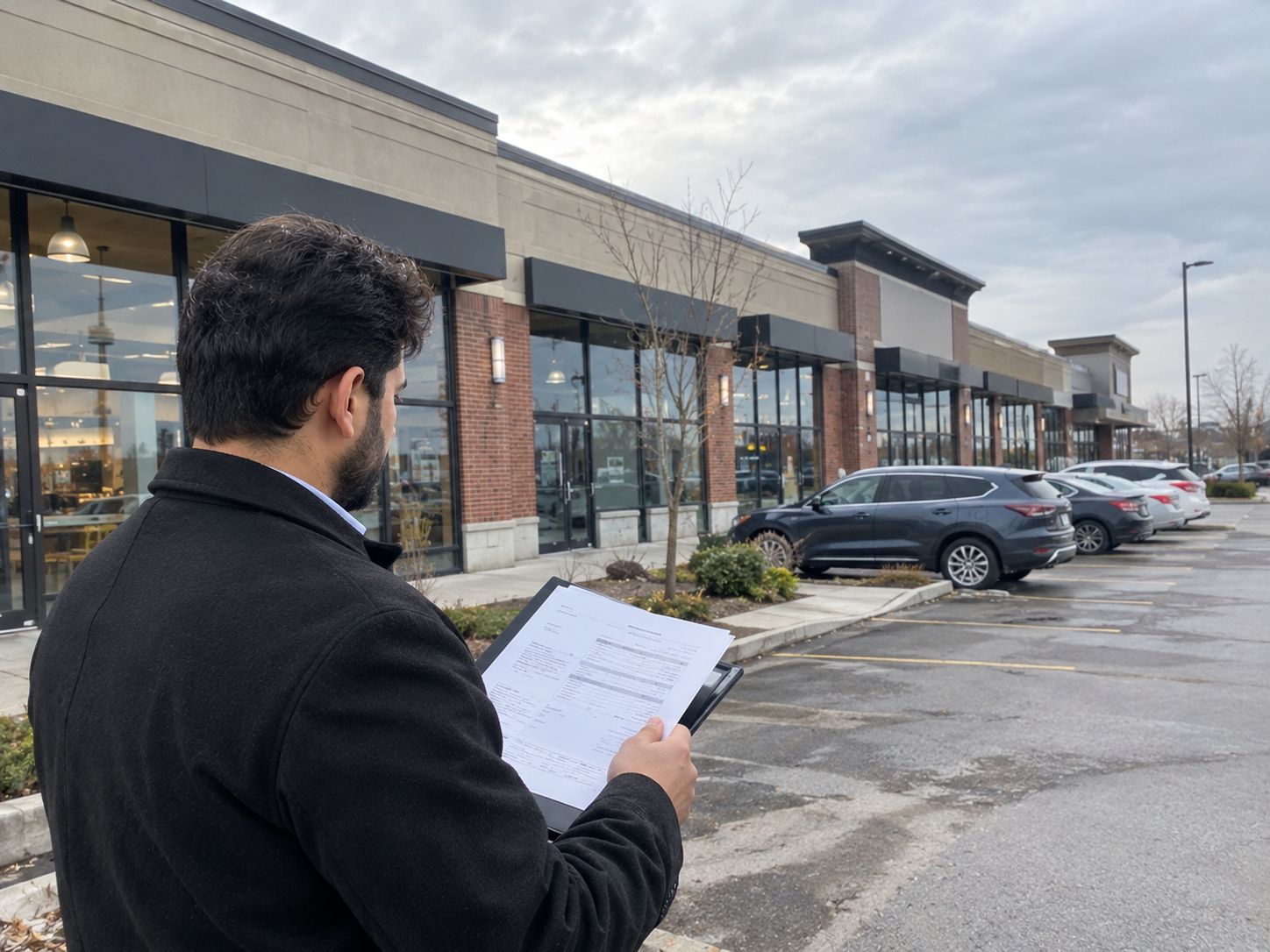
Commercial Property Tax Appeal in Toronto and the GTA: How to Challenge Your MPAC Assessment
Your property tax bill is based on a number MPAC assigned to your building. That number is their estimate of what your property would sell for on a specific valuation date. For commercial properties across Toronto and the GTA, that estimate is frequently wrong and sometimes wrong by a wide margin.
The owners who pay too much are almost never the ones who pushed back. The ones who pushed back are the ones who understood how the process works, what evidence actually moves the Assessment Review Board, and why a commercial appraisal is not optional if you want your appeal to succeed.
This guide covers all of it: the assessment cycle, the difference between RFR and ARB, what evidence standard applies to commercial files, and what you should do before your deadline passes.
What MPAC Does and Why Commercial Assessments Go Wrong
The Municipal Property Assessment Corporation assesses every property in Ontario. For residential properties, the comparison is relatively straightforward: houses sell frequently, the data is abundant, and MPAC can apply mass appraisal techniques with reasonable accuracy on large neighbourhoods.
Commercial properties are different. An office building in North York, a strip mall in Mississauga, or a warehouse in Brampton do not trade frequently. Comparable sales are sparse. The income the property generates, the lease terms in place, the tenant mix, the condition of the building systems, and the specific submarket all affect value in ways that mass appraisal cannot fully capture. MPAC assessors are working from general data. They are not walking your building, reviewing your rent roll, or accounting for the fact that your anchor tenant left two years ago and the space has been dark since.
The result is that commercial assessments in the GTA are regularly higher than the actual market value of the property, particularly for properties that have experienced vacancy, lease rollbacks, or physical deterioration since the last assessment cycle.
The current assessment cycle in Ontario uses a valuation date of January 1, 2016. The 2020, 2021, 2022, and 2023 reassessments were all frozen by the provincial government. A new reassessment cycle is expected, but until it takes effect, the 2016 value base continues to apply with phased-in adjustments. This matters because a 2016 value base applied to a commercial property whose market position has shifted significantly since then may bear little resemblance to current reality.
The Two-Stage Appeal Process: RFR Then ARB
Ontario’s property tax appeal process for commercial owners has two stages and understanding the distinction between them matters practically, not just procedurally.
Stage One: Request for Reconsideration
A Request for Reconsideration, or RFR, is filed directly with MPAC. It is an administrative review, not a formal hearing. You are asking MPAC to look again at their own assessment and correct it if they agree an error was made.
An RFR must be filed by March 31 of the tax year in question. For most commercial owners, this is the first step and the most cost-effective one. MPAC has an obligation to review the file and respond. In some cases, particularly where an obvious data error exists (wrong building size, wrong construction year, wrong property class), MPAC corrects the assessment at this stage without further process.
For commercial properties where the disagreement is about value rather than a data error, the RFR outcome is usually a confirmation of the original assessment. MPAC is not going to substantially reduce a commercial assessment based on your general disagreement with the number. For those files, the real battle is at stage two.
Stage Two: Assessment Review Board
The Assessment Review Board, or ARB, is an independent tribunal that hears property assessment appeals across Ontario. This is a formal adjudicative process. You file a Notice of Complaint with the ARB, both sides exchange evidence, and a hearing takes place before a tribunal member who issues a binding decision.
For commercial properties, the ARB operates at a meaningfully higher evidence standard than most owners expect. Filing a complaint is not enough. Showing up with a real estate agent’s opinion or a list of properties you think are worth less than yours is not enough. The ARB expects market value evidence that follows established appraisal methodology: comparable sales analysed and adjusted, income approaches supported by verified rent rolls and market data, and a conclusion prepared by someone who can be qualified and cross-examined.
The deadline to file a Notice of Complaint with the ARB is also March 31 of the tax year. You can file an RFR and an ARB complaint simultaneously, which preserves your options while MPAC conducts its review.
How Commercial Properties Are Assessed: The Three Approaches
To challenge an assessment effectively, you need to understand how MPAC arrived at it in the first place. For commercial properties, MPAC uses the same three approaches to value that an independent appraiser would use, though often with less granularity.
The direct comparison approach looks at sales of comparable commercial properties and derives a value per square foot or per unit. This works reasonably well for asset types that trade frequently in volume, such as industrial condos or small retail units. For larger or more specialised assets, comparable sales become scarce and the reliability of this approach drops.
The income approach capitalises the net operating income of the property to derive a value. MPAC applies market-based rent and expense assumptions rather than the actual income of the property. The problem is that their market assumptions may not reflect your specific tenant situation, your actual vacancy, or the below-market leases that may be dragging your income below what MPAC assumed.
The cost approach estimates the replacement cost of the improvements, deducts depreciation, and adds land value. MPAC uses this primarily for special-purpose properties and newer construction where the other approaches produce thin evidence.
When you challenge a commercial assessment, you are typically arguing that one or more of these approaches was applied incorrectly or that the weight given to each approach produced a conclusion that does not reflect market value. That argument requires evidence, not assertion.
Why the ARB Treats Commercial Appeals Differently From Residential
If you have been through a residential property tax appeal, the commercial process will feel significantly more demanding. The ARB applies the same legal standard to both: the assessed value must reflect the property’s current value as of the valuation date. But in practice, commercial appeals involve more complex evidence, longer hearing times, and a higher expectation that both parties will have professional appraisal support.
MPAC’s commercial assessment team employs accredited assessors and, on significant files, will bring a full AACI appraisal to the hearing in support of their assessed value. If you arrive at the ARB without equivalent professional evidence, the tribunal member has no independent basis to prefer your position over MPAC’s. The assessed value stands unless you give the ARB something better to work with.
The most common outcome for commercial appellants without professional appraisal support is a dismissal or a nominal reduction that does not reflect the actual over-assessment. The tribunal is not in a position to conduct its own valuation analysis. Their role is to weigh the evidence presented.
What the ARB is looking for on a commercial file: a credible opinion of market value as of the valuation date, prepared using appropriate methodology, by someone whose qualifications can be established and whose reasoning can withstand scrutiny from MPAC’s representative.
What Evidence Actually Works at the ARB for Commercial Properties
The following is what moves commercial appeals at the Assessment Review Board. Each element matters.
A Full Appraisal Report From an AACI-Designated Appraiser
The AACI designation, Accredited Appraiser Canadian Institute, is the AIC designation that covers all property types including commercial, industrial, multi-family, and special-purpose assets. A CRA-designated appraiser is limited to residential properties of up to four self-contained units. Bringing a residential appraiser to a commercial ARB hearing creates a qualification problem before you get to the evidence.
For properties at the ARB, the appraisal must be prepared in compliance with CUSPAP 2026, which took effect April 1, 2026. The report must state the effective date, the intended use, and the intended users clearly. It must consider all three approaches to value and explain the weighting applied. Adjustments must be stated with their derivation. A report that asserts conclusions without supporting the reasoning will not carry weight at the ARB.
An appraisal for property tax appeal purposes is also a form of expert evidence. The appraiser should understand that their duty runs to the tribunal, not to the property owner who retained them. A credible expert does not advocate for a position. They provide an independent, defensible opinion of value and explain their methodology clearly enough that the tribunal member can evaluate it on its merits.
Verified Income and Expense Documentation
For income-producing commercial properties, the actual income and expense history of the property is critical evidence. MPAC’s assessment is based on assumed market rents and expense ratios. If your actual performance is materially different, documented evidence of that difference supports a lower assessed value.
Bring the following: rent rolls for the assessment period, signed leases for all tenants, trailing 12-month operating statements, vacancy history, capital expenditure records, and any evidence of lease incentives or below-market arrangements that affect effective gross income. The goal is to show the tribunal what the property was actually generating, and why that diverges from MPAC’s assumed income.
Comparable Sales Evidence
If you are challenging the assessment on the basis that MPAC’s comparable sales analysis was flawed, you need better comparables and a clear explanation of why they are more appropriate than the ones MPAC used. This means identifying sales of properties that are genuinely comparable in asset class, size, location, age, condition, and lease profile, and adjusting for the differences between each comparable and your property with stated derivation for every adjustment.
Presenting a list of properties you believe sold for less, without analysis, does not constitute comparable sales evidence. The ARB needs to see the analytical work, not just the conclusion.
Expert Opinion of Market Value
Where the dispute is fundamentally about what the property was worth as of the valuation date, the most powerful evidence is a well-reasoned expert opinion that arrives at a different conclusion than MPAC’s assessed value and explains every step of how it got there. A full narrative appraisal report from an AACI-designated appraiser, structured for the ARB, is the standard form of that evidence on significant commercial files.
The connection between appraisal evidence and property tax appeals is also covered in the broader context of how appraisals support property tax appeals, which includes residential and mixed-use scenarios.
Commercial Property Types and Appeal Considerations
Different commercial asset classes raise different issues at the ARB. Here is what to watch for by property type.
Office Buildings
The GTA office market has undergone a significant repricing since 2020. Vacancy rates, particularly in suburban office product, have risen substantially. If MPAC’s assessment was built on income assumptions that reflected a pre-2020 occupancy profile, the assessed value may not reflect the current market position of the building. For office properties, lease-by-lease income analysis is critical, as is evidence of current submarket vacancy and the rental rates new tenants are actually paying.
The performance and valuation dynamics of GTA office product are covered in detail in Toronto Office Market Recovery 2026, which provides useful market context for assessments under appeal.
Retail Plazas and Strip Malls
Retail assessment issues often centre on anchor vacancy, below-market legacy leases, and the distinction between contract rent and market rent. If your anchor tenant left and the space has been vacant for two years, MPAC’s income assumption of market occupancy is not reflecting reality. Document the vacancy history, the leasing efforts made, and the market rent evidence for comparable inline and anchor space in your submarket.
Industrial and Logistics Properties
Industrial properties in the GTA generally assessed well under the current cycle because industrial values were rising strongly through 2021 and 2022. However, industrial properties with functional obsolescence, power constraints, clear height deficiencies, or access limitations may have been assessed at a rate that assumes a more functional building than you actually own. For specialised industrial assets, the cost approach and functional utility analysis become important parts of the evidence.
How industrial property appraisals work in the GTA provides background on how these assets are valued and what drives the adjustments that matter at the ARB.
Multi-Residential and Mixed-Use
Multi-residential properties are assessed using income capitalisation. If your building has rent-controlled units with rents materially below market, or if significant capital work has been required to maintain the building without a corresponding rent increase, the income the property actually produces may be substantially lower than MPAC assumed. Rent rolls, lease schedules, and operating cost documentation are the foundation of the evidence on these files.
For mixed-use properties with retail or commercial below and residential above, allocation between the residential and commercial components becomes important because they are assessed differently and may have different appeal deadlines and processes depending on how MPAC classified them.
Deadlines You Cannot Miss
The property tax appeal deadlines in Ontario are firm. Missing them means waiting for the next assessment year.
| Deadline | What It Covers |
| March 31 of the tax year | File RFR with MPAC |
| March 31 of the tax year | File Notice of Complaint with ARB |
| Within 90 days of RFR decision | File ARB complaint if RFR is denied |
| As directed by ARB | Exchange of evidence (typically 60 to 90 days before hearing) |
One important note: you do not have to wait for MPAC to respond to your RFR before filing with the ARB. Filing both simultaneously preserves your position. If MPAC resolves the RFR in your favour, you withdraw the ARB complaint. If they do not, you are already in the queue.
The ARB has experienced significant backlogs in recent years. Filing promptly means your hearing is scheduled sooner.
How Much Tax Savings Are Actually at Stake
The calculation is straightforward once you know the numbers.
Your property tax bill is your assessed value multiplied by the applicable tax rate for your property class. For commercial properties in Toronto, the commercial tax rate for 2026 is materially higher than the residential rate, and it applies to the full assessed value.
If MPAC has assessed your commercial building at $3,500,000 and the correct market value is $2,800,000, the over-assessment is $700,000. At a commercial tax rate of approximately 1.5 percent (illustrative, actual rates vary by municipality), the annual over-payment is approximately $10,500. Over a four-year assessment cycle, that is $42,000 in excess tax, plus the retroactive refund for prior years if your appeal succeeds.
On larger commercial assets, the numbers scale accordingly. A $5,000,000 over-assessment on a significant commercial property can mean six figures in recoverable tax over the appeal period.
The cost of a professional appraisal for an ARB submission is a fraction of what a successful appeal recovers.
The Role of an AACI Appraiser in Your Commercial Tax Appeal
IPS provides appraisal reports prepared specifically for Assessment Review Board submissions on commercial properties across Toronto and the GTA.
The process starts with a review of your current MPAC assessment and the property details. Where the evidence supports a challenge, IPS prepares a full narrative appraisal report using CUSPAP 2026 methodology, with comparable sales analysis, income approach where applicable, and a clear reconciliation of value. The report is structured to serve as expert evidence at the ARB: clear methodology, documented reasoning, and a conclusion that can withstand scrutiny from MPAC’s representative.
Ehsan Hassani, P.App., AACI, P.Eng., R/W-AC, MBA holds the AACI designation, the credential required for commercial property appraisal work in Ontario. His engineering background is particularly relevant on industrial and special-purpose files where the physical characteristics of the building affect the functional utility analysis.
For a broader understanding of how commercial property values are determined and what drives the adjustments in a formal appraisal, the guide on how to value commercial property in Toronto provides useful background.
Frequently Asked Questions
Do I need a professional appraisal to appeal my commercial property tax assessment in Ontario?
You are not legally required to have one. But for any significant commercial file, presenting at the ARB without professional appraisal evidence puts you at a serious disadvantage. MPAC will typically have their own assessors and, on larger files, an AACI appraiser supporting their position. Without equivalent evidence on your side, the tribunal has no independent basis to prefer your number.
What is the difference between an RFR and an ARB complaint for commercial properties?
An RFR is an administrative review filed directly with MPAC. It is the first step and the lower-cost option, but it is limited in scope. MPAC reviews their own assessment and confirms or adjusts it. An ARB complaint is a formal tribunal process with hearings, evidence exchange, and a binding decision from an independent adjudicator. For most significant commercial over-assessments, the ARB is where the appeal is actually resolved.
What valuation date does MPAC use for commercial assessments?
The current assessment cycle in Ontario uses January 1, 2016 as the valuation date. The 2020 through 2023 reassessments were frozen by the provincial government and that base value continues with phased-in adjustments. Your appraisal evidence for an appeal must reflect the value of the property as of that valuation date, not current market value.
Can I appeal my commercial assessment myself without a lawyer or appraiser?
You can. Small commercial files are sometimes successfully appealed by owners who prepare their own evidence carefully. But the ARB evidence standard for commercial properties is demanding, and MPAC’s commercial team is experienced. For any file where the tax at stake is material, professional representation and a qualified appraisal report significantly improve the outcome.
How far back can I recover overpaid property tax if my appeal succeeds?
A successful ARB appeal typically results in a refund for the years covered by your complaint, which can be multiple years within the same assessment cycle. The specific years recoverable depend on which tax years your complaint covered and the ARB’s order.
How long does a commercial property tax appeal take in Ontario?
Timeline varies. An RFR is typically resolved by MPAC within a few months of filing. ARB hearings are subject to scheduling, and the board has experienced backlogs. Depending on the complexity of the file and the ARB’s calendar, a commercial appeal may take one to three years from filing to final decision. This is one reason early filing matters.
What commercial property types does IPS appraise for tax appeal purposes?
IPS handles office, retail, industrial and logistics, multi-residential, mixed-use, development land, and special-purpose commercial properties across Toronto and the broader GTA including Mississauga, Vaughan, Markham, Richmond Hill, Brampton, Oakville, Pickering, Ajax, and Whitby.
Get a Commercial Appraisal for Your Property Tax Appeal
If your commercial property assessment does not reflect market value, the time to act is before the March 31 deadline. IPS provides CUSPAP-compliant appraisal reports prepared for ARB submission across all commercial asset classes in Toronto and the GTA.
Scope and fee are confirmed in writing before work begins. Contact IPS at +1 (437) 908-0098 or info@ipsrealty.ca, or submit your details through the contact page.


