
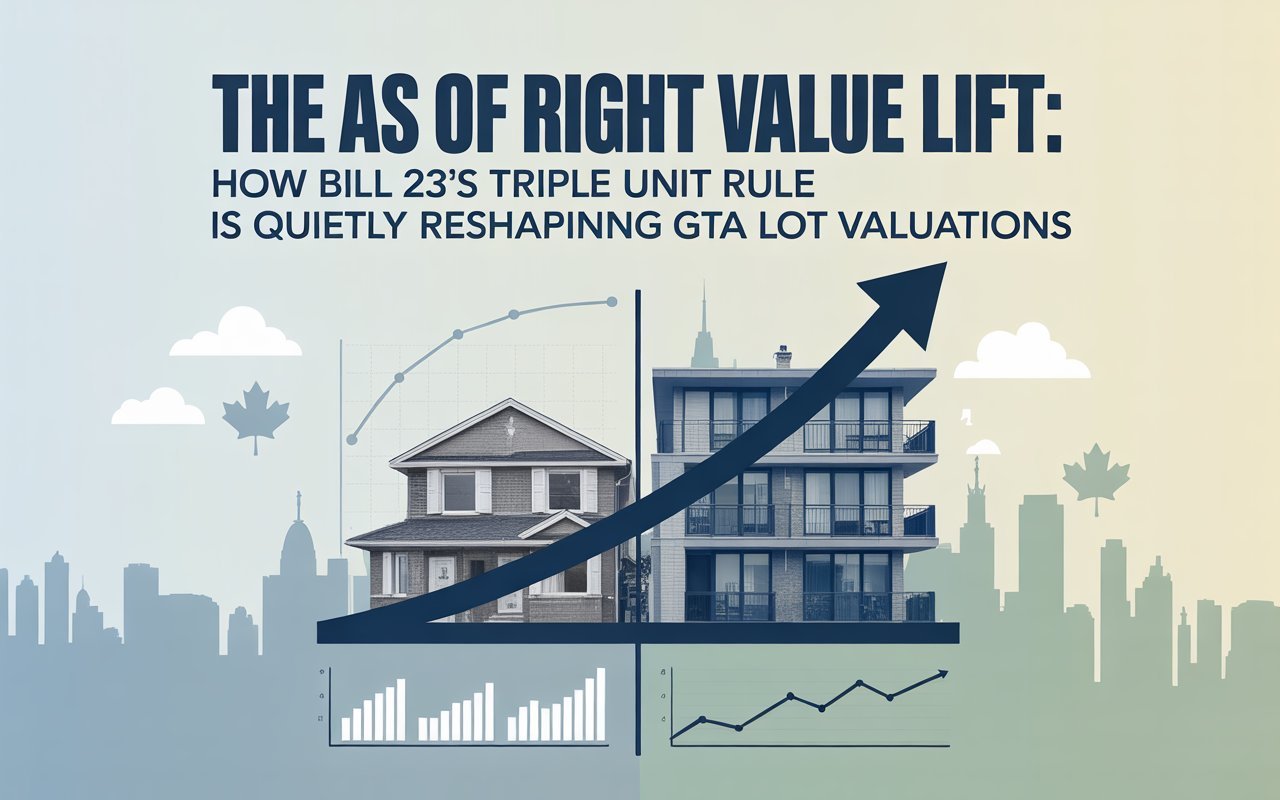
The As of Right Value Lift: How Bill 23’s Triple Unit Rule Is Quietly Reshaping GTA Lot Valuations
When Ontario’s Bill 23 came into effect, much of the public conversation focused on housing supply, affordability, and planning reform. What received far less attention was how profoundly this legislation has altered land value across the Greater Toronto Area, especially for properties that still look like ordinary single-family homes on the surface.
From the perspective of a professional appraiser working daily across Toronto and the surrounding GTA markets, one of the most significant changes introduced by Bill 23 is the ability to build up to three residential units on most urban residential lots without rezoning. This single policy shift has created what many of us in valuation quietly refer to as an “as of right value lift.”
It is real land value that exists today, even if nothing has been built yet. And in many cases, it is a value that traditional appraisal approaches still fail to fully recognize.
This article breaks down what that value lift really means, why it matters for homeowners, investors, and lenders, and how lot valuations in Toronto are evolving as a result.
Understanding Bill 23 and the Triple Unit Rule in Simple Terms
Bill 23, also known as the More Homes Built Faster Act, fundamentally changed zoning permissions across much of Ontario’s urban residential landscape. In practical terms, the legislation allows property owners to develop up to three residential units on a single residential lot, provided basic planning and building code requirements are met.
For most Toronto neighbourhoods zoned for detached housing, this means a property that previously supported one dwelling unit can now legally support three. This can take the form of a triplex, a primary dwelling with a secondary suite and garden suite, or other compliant configurations, depending on lot characteristics.
The keyword here is as of right. No rezoning. No minor variance hearings. No planning appeals.
From a valuation standpoint, that distinction changes everything.
Why As of Right Permissions Create Invisible Land Value
Land value is driven by what can legally and reasonably be built on a site. Historically, many residential lots in Toronto were appraised under the assumption that their highest and best use was limited to a single dwelling. Even if intensification was theoretically possible, the cost, risk, and uncertainty of rezoning meant that value was often discounted or ignored altogether.
Bill 23 removes that uncertainty.
When a property can support three units as of right, the land is no longer simply a single-family lot. It becomes a low-density multi-unit development site in disguise. The market recognizes this faster than appraisal models often do.
As appraisers, we see this play out regularly. Two identical homes on similar streets can trade at very different prices if one buyer understands the development potential and the other does not. The building itself may not justify the premium, but the land certainly does.
This is the invisible value lift created by Bill 23. It exists even before a single shovel hits the ground.
How This Changes Highest and Best Use Analysis in Toronto
Highest and best use analysis sits at the core of professional appraisal practice. It asks a simple but powerful question: what use of the property is legally permissible, physically possible, financially feasible, and maximally productive?
Before Bill 23, many single-family properties failed the legal permissibility test for multi-unit use without rezoning. Today, that barrier is gone for much of Toronto.
As a result, highest and best use conclusions are shifting. In many neighbourhoods, the highest and best use of a so-called single-family lot may no longer be a single-family home at all. It may be a triplex or small-scale income property.
This does not mean every property automatically jumps in value. Physical constraints, lot frontage, depth, servicing, parking requirements, and construction economics still matter. But the ceiling has moved higher.
A professional appraisal that continues to value land solely through single family comparable sales risks understating real market value.
Where the Value Lift Is Most Visible Across Toronto
Not all neighbourhoods experience the as-of-right value lift equally. In practice, the strongest impact is seen in areas with the following characteristics:
Established residential neighbourhoods with strong rental demand, proximity to transit corridors including subway lines and major bus routes, lot sizes that can accommodate compliant unit layouts, and areas where new low-rise development activity is already occurring.
Older Toronto neighbourhoods with aging housing stock often show the clearest uplift. In these areas, buyers are less focused on the existing structure and more focused on what the site can become.
In contrast, newer subdivisions with restrictive site constraints or areas with weak rental fundamentals may see more modest impacts.
This is where local appraisal expertise becomes critical. The value lift is not theoretical. It is market-driven and location-specific.
Why Traditional Appraisals Can Miss This Value
Many residential appraisals still rely heavily on direct comparison to nearby single-family home sales. While this approach remains valid for many purposes, it can fall short when zoning permissions materially change land potential.
If comparable sales are selected without adjusting for redevelopment potential, or if the highest and best use analysis remains anchored to legacy zoning assumptions, the appraisal may not reflect current market reality.
This gap often surfaces during refinancing, estate planning, partnership buyouts, or private transactions where one party senses untapped value but cannot articulate it through standard valuation language.
As appraisers actively working in Toronto, we increasingly integrate redevelopment adjusted comparables, land residual analysis, and income-based scenarios when appropriate. This does not inflate value. It reflects it.
What This Means for Homeowners
For homeowners across Toronto, Bill 23 has quietly changed the equity profile of many properties.
A home that was once valued purely as a place to live may now carry additional value as a small scale development site. Even if the owner has no intention of building additional units, the market recognizes that someone else might.
This matters when refinancing, selling, or planning for long-term wealth transfer. An appraisal that fails to consider as-of-right permissions may leave money on the table.
It also matters for property tax appeals, family settlements, and informed decision-making around renovations versus redevelopment.
What This Means for Investors and Developers
For investors, the as-of-right value lift is both an opportunity and a risk.
The opportunity lies in identifying properties where the market has not yet fully priced in the development potential. The risk lies in assuming that every lot automatically supports profitable intensification.
Construction costs, financing, municipal servicing capacity, and market rents all play a role. A professional appraisal grounded in Toronto market realities helps separate viable projects from speculative ones.
The smartest investors we work with treat Bill 23 permissions as a value enhancer, not a guarantee.
Why Lenders Are Paying Closer Attention
Lenders are increasingly aware that zoning permissions affect collateral value. In some cases, development potential can strengthen loan security. In others, it introduces complexity around valuation methodology.
Well-supported appraisal reports that clearly explain as-of-right permissions, development scenarios, and risk factors help lenders make informed credit decisions. This is particularly important for construction financing, refinancing, and private lending arrangements.
The Role of the Modern GTA Appraiser
The appraiser’s role is no longer just to report what sold yesterday. It is to interpret how planning policy, market behaviour, and land economics interact today.
Bill 23 has raised the bar for residential land valuation across Toronto. Appraisals that ignore their impact risk becoming outdated the moment they are delivered.
At Innovative Property Solutions, our approach reflects what we see on the ground every day. We analyze zoning, assess real development feasibility, and apply valuation methods that align with how informed buyers and sellers actually think.
That is how invisible value becomes measurable value.
Final Thoughts: Value Exists Before the Build
The most important takeaway from Bill 23’s triple unit rule is this: land value can change without any physical change to the property itself.
The ability to build three units as of right has altered the economic potential of thousands of Toronto lots. That potential is now part of the market, whether it is recognized or not.
For property owners, investors, and lenders navigating this new landscape, understanding the as-of-right value lift is no longer optional. It is essential.
And it starts with an appraisal that reflects today’s Toronto, not yesterday’s zoning map.


