
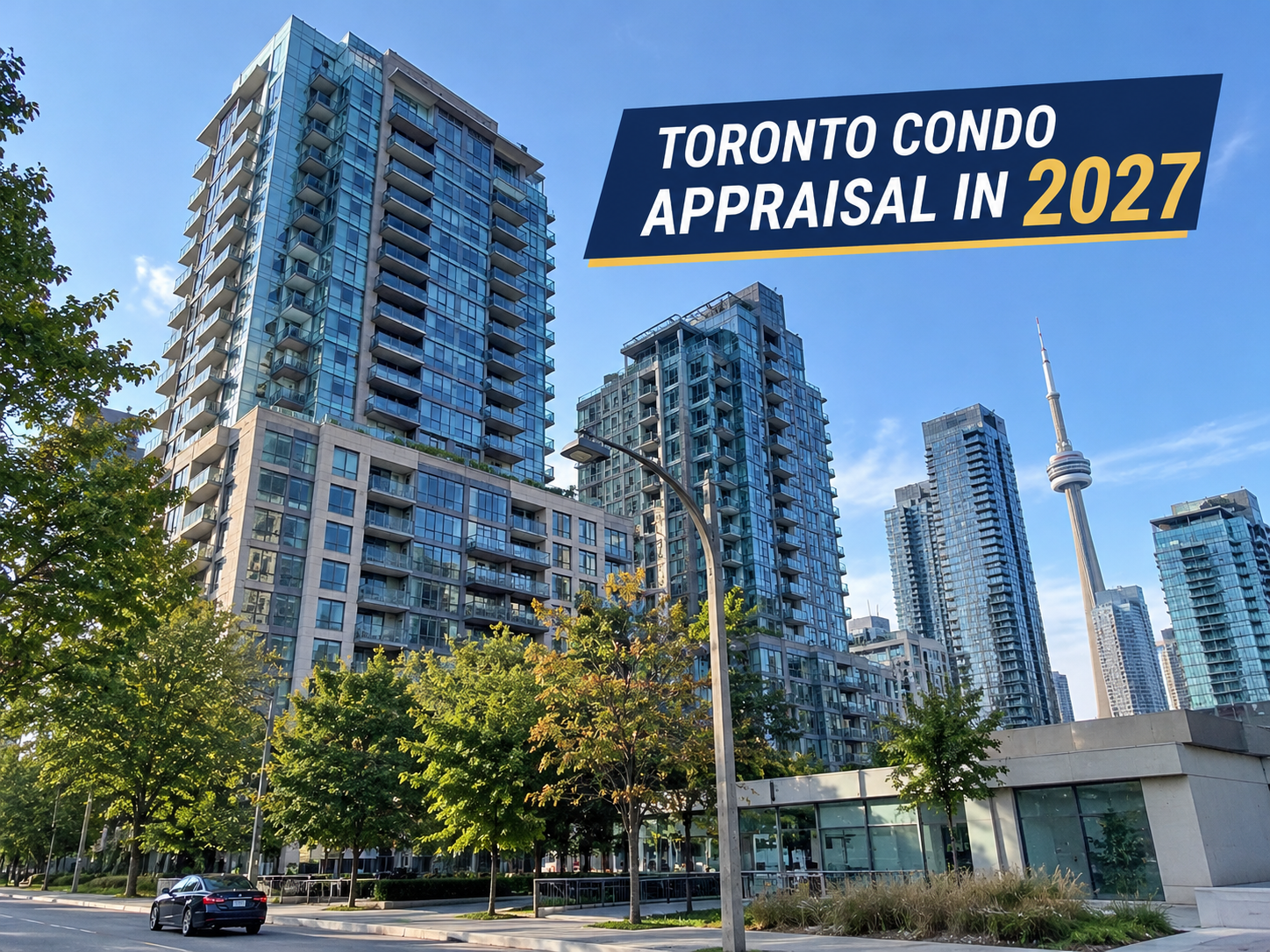
Toronto Condo Appraisals in 2027: What Investors Need to Know Right Now
If you bought a pre-construction condo in Toronto between 2019 and 2022, the next twelve months may be the most financially consequential period of that investment. Units are completing. Closings are arriving. And the appraisal that arrives with them is not coming back at the number you signed for.
The Greater Toronto Area’s new condominium development sector has entered a deep freeze, with pre-construction sales plummeting to levels not seen since the global financial crisis. New condo sales in the Greater Toronto Hamilton Area fell 60% in 2025 to just 1,599 units, the lowest annual total since 1991 and a 95% drop from 2021. rbczoocasa
That collapse matters to you as an investor not because of what it means for future buyers, but because of what it means for your appraisal today. When comparable sales dry up and completed inventory floods the market, appraised values follow the evidence. And right now the evidence points lower.
This guide explains what is happening, what your certified appraisal needs to reflect, and what your options are depending on which investor situation you are in.
Why Condo Appraisals in Toronto Are So Difficult Right Now
Appraising a condo in the GTA in 2027 is not the same exercise it was in 2021. The market has changed in ways that make the appraiser’s job genuinely harder, and that difficulty translates directly into consequences for investors at closing.
Floods of investors who bought pre-construction condos in recent years are now confronted with the prospect of big losses on their units, with prices sinking and buyers facing an appraisal crisis, suddenly unable to secure a mortgage for the price they originally agreed to pay. mpamag
The core problem for appraisers is comparable evidence. To value a completed condo, an appraiser needs recent sales of similar units in similar buildings. When sales volumes hit a 34-year low, the pool of comparable evidence shrinks dramatically. Appraisers are forced to reach further back in time or further out geographically to find comparables — and both adjustments introduce more uncertainty into the final value.
The appraisal crisis sweeping the market may have further to run. “Some of the new construction completions right now aren’t appraising at the original value — but we haven’t hit the worst of it yet,” according to appraisal industry observers tracking the GTA market. mpamag
CMHC’s condo market risks report shows some Toronto pre-construction buyers who closed in 2024 faced losses of up to 6%. For investors closing in 2027 on units purchased at 2021 prices, the gap can be considerably larger. zoocasa
The Three Investor Situations That Need an Appraisal in 2027
Not every condo investor needs an appraisal for the same reason. Here are the three situations IPS sees most frequently in the GTA right now, and what each one requires.
Situation One: Your Pre-Construction Unit Is Closing and You Need Mortgage Financing
This is the most urgent scenario. Your closing date is set. The developer expects full payment. Your lender has ordered an appraisal, or you are about to arrange financing. The appraisal will determine how much your lender will lend against the unit — and in this market, that number is often materially lower than the purchase price you signed.
Toronto’s pre-construction condo market is facing a crisis, with buyers abandoning their purchases as appraisals come in significantly below their original contract prices. mpamag
If the appraisal comes in at $610,000 on a unit you purchased for $750,000 and your lender caps financing at 80% of appraised value, your maximum loan is $488,000. You expected $600,000. The $112,000 gap has to come from somewhere — additional equity, a second mortgage, a renegotiated purchase price, or a decision not to close.
Getting an independent certified appraisal from IPS before the lender’s appraiser arrives gives you one thing the lender’s timeline does not: options. You learn where the value stands while there is still time to negotiate with the developer, explore alternative financing, or structure a bridge solution with your mortgage broker.
For a full breakdown of exactly how the pre-construction appraisal process works, including the as-if-complete methodology and what happens when the value comes in below your purchase price, our pre-construction condo appraisal guide for Toronto investors covers every scenario in detail.
Situation Two: You Are Considering Buying a Distressed Assignment or Completed Unit
The other side of the appraisal crisis is an opportunity. Active distressed assignment listings are appearing across downtown Toronto and the wider GTA, with implied capital losses relative to original purchase prices in many cases. Investors who bought pre-construction at peak prices and cannot close are selling their assignment rights at a discount. zoocasa
If you are considering buying one of these distressed assignments or a completed unit priced below original pre-construction cost, you need an appraisal before you commit. Not because the low price is suspicious, but because “discounted from pre-construction price” and “fair market value” are two different numbers in this market.
An independent certified appraisal tells you what the unit is actually worth today, based on the most current comparable sales available. That number sets your maximum offer, your financing ceiling, and your holding strategy. Without it, you are negotiating from a seller’s reference point rather than a market one.
Situation Three: You Already Hold the Unit and Need to Refinance, Sell, or Settle
Investors who closed on condo units in 2023, 2024, or early 2025 and are now trying to refinance, sell, or settle a partnership or divorce involving the unit need a current certified appraisal for each of those purposes.
In the detached space, prices edged 2% lower year over year. Semi-detached prices fell by 4.6%, while townhouses posted a 3.1% decline and the condo sector saw a 9.5% slump — the steepest decline of any property type in the GTA. If your refinancing plans are based on what you paid or what the market looked like eighteen months ago, the appraisal will likely come in below your expectations. mpamag
For investors navigating separation or partnership dissolution where a condo is among the assets, the fair market value as of the specific effective date is what goes into the financial calculation — not the purchase price, not the most recent listing you saw, and not the developer’s original pricing. The certified appraiser establishes that number, and the lawyers and accountants work from it.
For more on how property appraisals work in separation and divorce proceedings in Ontario, our divorce and property division appraisal guide for Toronto covers the Net Family Property framework and what the Valuation Date means for condo assets.
What Makes a Condo Appraisal Different From a House Appraisal
GTA investors sometimes assume a condo appraisal is a simpler version of a house appraisal. It is not. It is a different analytical exercise, and in the current market environment, it is a considerably more demanding one.
Comparable selection is harder. A detached house appraiser can usually find multiple recent sales of similar homes within a reasonable distance. A condo appraiser needs sales of units with similar floor plans, floor positions, exposures, finish levels, and building amenities — often within the same building or a very similar one nearby. When the building is newly completed and few units have traded, the appraiser must reach further for evidence and apply more careful adjustments.
Maintenance fees affect value. A condo with higher monthly maintenance fees is less attractive to buyers than a comparable unit with lower fees, and the appraiser adjusts for this. Investors who assumed maintenance fees were a neutral factor are sometimes surprised by how much weight they carry in the value analysis.
Floor position and exposure matter more than many investors expect. A unit on the 25th floor with a south-facing lake view and a unit on the 6th floor facing a neighbouring building are not the same asset, even if the floor plans are identical. The appraiser quantifies that difference based on market evidence of what buyers actually pay for those attributes in this market, not in the market of three years ago.
New construction versus resale premiums have collapsed. For years, buyers paid a premium for new construction over comparable resale units. Buyer appetite that traditionally fuelled Toronto’s pre-construction market has largely evaporated, driven by a sobering reassessment of investment fundamentals. Buyers today gravitate toward existing inventory first, drawn by immediate availability and competitive pricing. The new construction premium has essentially disappeared in many segments of the GTA condo market, and the appraisal reflects that reality. rbc
What the 2027 Condo Market Means for Investors Looking Further Ahead
If you are holding a GTA condo through the current downturn, the medium-term picture is more constructive than the headlines suggest.
Condo construction starts fell 63% from 8,854 units in 2024 to 3,272 units in 2025, a multi-decade low. In the last three years, condo starts have plunged 88%, bringing the total inventory under construction down to a 10-year low. Completions are expected to decrease by 25% in 2026 to 22,066 units before dropping to 14,366 units in 2027. urbanation
With very few new multifamily construction starts happening, the overhang of supply from launches earlier in the decade will end in late 2027 or early 2028. Based on current under-construction inventory and expected starts, the Greater Toronto Area will see delivery of less than 10,000 condo and rental apartments in 2028, when the market will likely need at least 25,000 to satisfy demand. renx
That supply gap has real consequences for condo values beyond 2027. The investors who hold through the current appraisal pressure and into the tightening supply environment of 2028 and 2029 are likely to find the market considerably more supportive of their position.
The current appraisal crisis is real and the numbers are genuinely difficult for investors closing in 2027. But the structural supply story heading into 2028 and 2029 is the strongest argument for holding that GTA condo investors have had in several years.
That said, knowing your current certified value is what lets you make that hold-versus-sell decision from a position of information rather than assumption. An investor who knows their unit is worth $615,000 today and can hold for two to three years makes a different decision than one who assumes it is worth $750,000 and plans accordingly.
Frequently Asked Questions
What is the difference between an as-if-complete appraisal and a standard condo appraisal?
An as-if-complete appraisal values a unit that has not yet been physically completed, using the specifications in the purchase agreement and disclosure documents. It is used for pre-construction closings where the unit is still under construction at the time the appraisal is ordered. A standard appraisal values a unit that exists and can be physically inspected. Both types are prepared by AACI certified appraisers under CUSPAP standards, but the as-if-complete appraisal requires disclosure of the extraordinary assumption that construction completes as proposed.
Can I use an IPS appraisal to challenge the developer on purchase price?
Yes. Where there is a material gap between your purchase price and the certified appraised value, an AACI appraisal prepared by IPS provides defensible, professional evidence for a developer negotiation. Some developers will renegotiate purchase prices where multiple buyers in the same project face the same appraisal shortfall and the developer needs closings to proceed. An independent appraisal is far more persuasive in that conversation than an unsupported claim that the market has moved.
My closing is in six weeks. Is there time to get an independent appraisal?
Standard turnaround for a residential condo appraisal at IPS is five to seven business days. Rush timelines are available where closing deadlines require them. Contact us as soon as you know your closing date — six weeks is workable, two weeks is tight but possible, and less than two weeks is an emergency timeline that we handle on a case-by-case basis.
What if the lender’s appraisal comes in below my purchase price and I cannot close?
Your options include funding the shortfall with additional equity, negotiating a price reduction with the developer supported by the independent appraisal, exploring alternative or private lenders with different underwriting criteria, attempting an assignment sale if your contract permits it, or assessing the contractual consequences of not closing. Legal counsel advises on the contractual options. The appraisal is the document that supports every other conversation. For a full walkthrough of the options when a GTA appraisal comes in below what you need, see our guide on what to expect from a mortgage refinancing appraisal in Toronto.
Does IPS appraise condos across the GTA or only in specific areas?
IPS prepares condo appraisals across the full GTA including Toronto, Mississauga, Vaughan, Markham, Richmond Hill, Oakville, Scarborough, Etobicoke, North York, and surrounding communities. All appraisals are prepared by AACI designated appraisers under CUSPAP standards.
Talk to IPS Before Your Condo Closing or Refinancing
Innovative Property Solutions (IPS) prepares certified condo appraisals across Toronto and the GTA for investors, lenders, lawyers, and accountants. Whether your unit is pre-construction approaching closing, completed and held for refinancing, or involved in a separation or partnership settlement, we scope the engagement to your specific situation and deliver on timelines that fit your deadline.
Call +1 (437) 908-0098 or use the contact form below. Written fee quote within one business day.

