
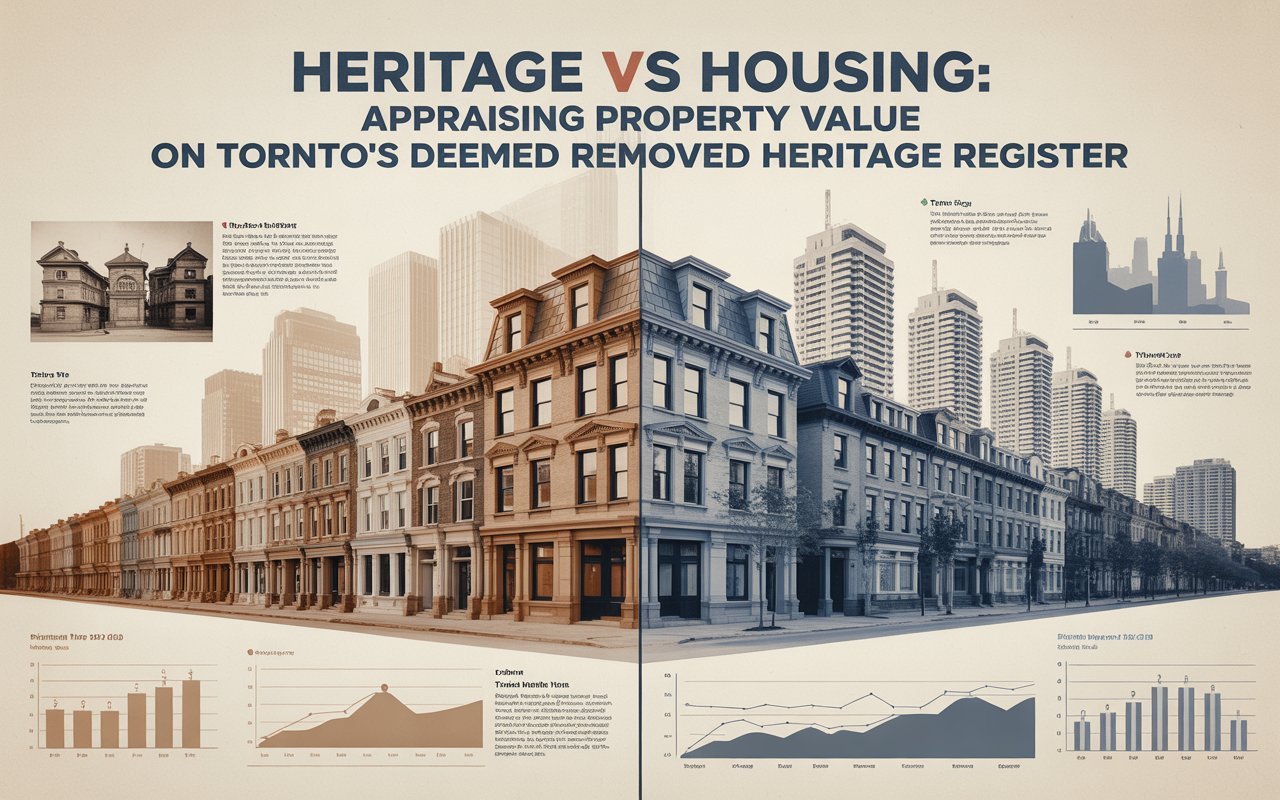
Heritage vs Housing: Appraising Property Value on Toronto’s Deemed Removed Heritage Register
Toronto is approaching a quiet but consequential deadline that many property owners, executors, and investors are only beginning to understand. On January 1, 2027, more than 3,700 properties currently listed on the City of Toronto’s Heritage Register will automatically lose their heritage status if they are not formally designated. This process is commonly referred to as “deemed removed.”
From an appraisal perspective, this is not just a planning or heritage issue. It is a land value event.
For decades, inclusion on the Heritage Register acted as a soft but powerful constraint on development potential. Even without full designation, these listings influenced buyer behaviour, lender appetite, redevelopment feasibility, and ultimately property value. When that constraint disappears, the highest and best use of a property can change overnight.
As professional appraisers at Innovative Property Solutions (IPS), we are already seeing early market signals that this upcoming shift is unlocking development value across multiple Toronto neighbourhoods. For property owners and estate executors, especially, understanding this change now rather than after 2027 can have major financial consequences.
This article explains what is deemed removed really means, how it affects property value, and why a professional appraisal is critical before making any decisions.
What Does Deemed Removed Actually Mean
Under the Ontario Heritage Act, municipalities were required to either formally designate properties on their Heritage Register or remove them by January 1, 2027. Properties that are not designated by that deadline automatically lose their heritage listing status.
Once removed, these properties are no longer subject to heritage review or demolition delay related to heritage listing. In practical terms, they are treated like any other non-heritage property under zoning and planning rules.
This does not mean that every deemed removed property can suddenly be redeveloped without restriction. Zoning bylaws, official plans, and other regulations still apply. However, one major layer of uncertainty and delay disappears.
From a valuation standpoint, that matters.
How Heritage Listing Has Historically Suppressed Value
Even without formal designation, heritage-listed properties often carried what appraisers refer to as a regulatory discount. Buyers factored in longer approval timelines, additional consultant costs, uncertainty around alterations, and risk of future designation.
Lenders were more conservative. Developers adjusted their residual land values downward. Estate beneficiaries often struggled to understand why a seemingly well-located property attracted lower offers than expected.
This impact was not theoretical. It showed up in sale prices, marketing time, and feasibility studies.
When a property becomes deemed removed, that discount can narrow or disappear depending on location and development potential. The market begins to price the land based on what it can become, not what it might be restricted from becoming.
Why Deemed Removed Status Unlocks Development Value
The key valuation concept here is highest and best use. A property’s value is driven by the most profitable use that is legally permitted, physically possible, financially feasible, and supported by the market.
For many heritage-listed properties, the legal permissibility test was clouded by heritage controls. Once deemed removed, the analysis becomes clearer.
In neighbourhoods with strong intensification demand, transit access, and favourable zoning, the removal of heritage status can shift the highest and best use from a single residential dwelling to a multi-unit or mixed-use redevelopment site.
Even if the existing structure remains, the land underneath it may now carry additional development value that did not previously exist in the eyes of the market.
This is where professional appraisal becomes essential. The value shift is rarely obvious from online estimates or past tax assessments.
What Executors and Estate Trustees Need to Know Now
Estate situations are where this issue becomes especially sensitive.
Executors have a fiduciary duty to act in the best financial interests of beneficiaries. Selling a property without understanding its true market value can expose executors to disputes and legal challenges.
If an estate property is currently on the Heritage Register but likely to be deemed removed in 2027, timing matters. So does valuation methodology.
An appraisal that ignores upcoming heritage status changes may understate value. An appraisal that speculates without proper analysis may overstate it. What is required is a defensible, evidence-based opinion of value that reflects current market conditions and foreseeable changes.
At IPS, we are increasingly asked to provide estate appraisals that consider both current use value and redevelopment potential under deemed removed scenarios. This helps executors make informed decisions about whether to sell now, hold, or reposition the asset.
Market Behaviour Is Already Shifting
Although the official deadline is still approaching, sophisticated buyers are already factoring the deemed removed status into their acquisition strategies.
We are seeing increased interest in properties that remain listed but are unlikely to be designated. In some cases, offers reflect future redevelopment potential rather than existing use alone.
This does not mean prices have universally jumped. It does mean the gap between informed and uninformed pricing is widening.
A professional appraisal helps bridge that gap by translating planning policy into real market value.
Appraisal Challenges in Deemed Removed Cases
Appraising these properties is more complex than a standard residential valuation.
Comparable sales must be carefully selected and adjusted to reflect heritage status differences. Highest and best use analysis must be supported by zoning review, planning context, and market evidence. Development potential must be assessed realistically, not optimistically.
This is not an area where automated valuation models or generic reports provide reliable guidance.
At Innovative Property Solutions, our appraisal process integrates zoning analysis, policy review, and local market behaviour. We explain not just what a property is worth, but why.
Why Professional Appraisal Matters More Than Ever
Whether you are a homeowner, investor, or executor, the deemed removed transition represents both opportunity and risk.
Relying on outdated assumptions about heritage restrictions can lead to undervaluation. Assuming automatic redevelopment upside without analysis can lead to overpricing and failed transactions.
A professional appraisal provides clarity. It supports informed decision making, defensible reporting, and smoother negotiations with buyers, lenders, and beneficiaries.
How IPS Supports Clients Through This Transition
Innovative Property Solutions has deep experience appraising properties across Toronto with complex planning and regulatory considerations. We understand how heritage policy, zoning changes, and market dynamics intersect.
Our appraisals are used for estate settlements, financing, sales, acquisitions, and strategic planning. We take the time to explain the implications of deemed removed status in plain language so clients can move forward with confidence.
Call to Action: Get Ahead of the 2027 Deadline
If you own or manage a property on Toronto’s Heritage Register, or if you are acting as an executor for an estate asset, now is the time to understand its true value.
Do not wait until heritage status changes catch you off guard or leave value unrealized.
Contact Innovative Property Solutions to schedule a professional appraisal tailored to the deemed removed heritage properties. Our local expertise and clear analysis will help you make informed decisions in a rapidly changing Toronto real estate landscape.
Understanding value today is the smartest way to protect value tomorrow.


